
Approach
Putting people first
Community Action Marin breaks down the barriers that get in the way of fair and lasting change, responds to urgent and pressing community needs, and advocates to eliminate the social inequities that hinder people’s ability to thrive. We put people first and create trusted connections in community to support greater well-being.
We strive to meet the needs of community by preventing homelessness, ensuring healthy meals, educating preschoolers of working parents, offering cash assistance, providing emotional support, and helping people to achieve well-being.
The agency’s Whole Family Approach is designed to ensure improved outcomes at the individual, agency, and community levels. See our 2025 Community Needs Assessment which will guide us for the next two years.
Meeting the needs of the whole family
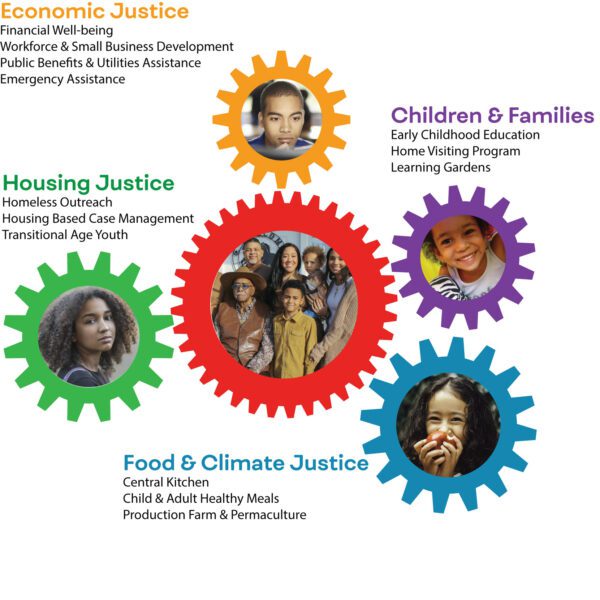
How we work is critical to achieve our goals. There is no wrong door here. Strong, trusted relationships make self-sufficiency possible for over 5,000 households each year—and growing.
- Children and Families: Free and affordable early childhood education to support people across generations and help families thrive
- Housing Justice: Through the provision of direct services like Homeless Outreach, Housing Navigation, as well as advocacy, we are advancing housing justice locally
- Economic Justice: Help with income taxes, credit coaching, budgeting, job training, and career support to stabilize and promote pathways to employment and financial health
- Food and Climate Justice: Access and advocacy to grow food security across the county
In accordance with Federal civil rights law and U.S. Department of Agriculture (USDA) civil rights regulations and policies, the USDA, its Agencies, offices, and employees, and institutions participating in or administering USDA programs are prohibited from discriminating based on race, color, national origin, religion, sex, disability, age, marital status, family/parental status, income derived from a public assistance program, political beliefs, or reprisal or retaliation for prior civil rights activity, in any program or activity conducted or funded by USDA (not all bases apply to all programs). Remedies and complaint filing deadlines vary by program or incident.
Persons with disabilities who require alternative means of communication for program information (e.g., Braille, large print, audiotape, American Sign Language, etc.) should contact the State or local Agency that administers the program or contact USDA through the Telecommunications Relay Service at 711 (voice and TTY). Additionally, program information may be made available in languages other than English.
To file a program discrimination complaint, complete the USDA Program Discrimination Complaint Form, AD-3027, found online at How to File a Program Discrimination Complaint and at any USDA office or write a letter addressed to USDA and provide in the letter all of the information requested in the form. To request a copy of the complaint form, call (866) 632-9992. Submit your completed form or letter to USDA by: (1) mail: U.S. Department of Agriculture, Office of the Assistant Secretary for Civil Rights, 1400 Independence Avenue, SW, Mail Stop 9410, Washington, D.C. 20250-9410; (2) fax: (202) 690-7442; or (3) email: program.intake@usda.gov.
USDA is an equal opportunity provider, employer, and lender.