
By Richard Halstead
rhalstead@marinij.com
When Vilma Monzon and her 8-year-old daughter Joselin Ordoñez Monzon received the notice they had to vacate their Novato home — the apartment Joselin had lived in her entire life — they had just three days to pack up and get out.
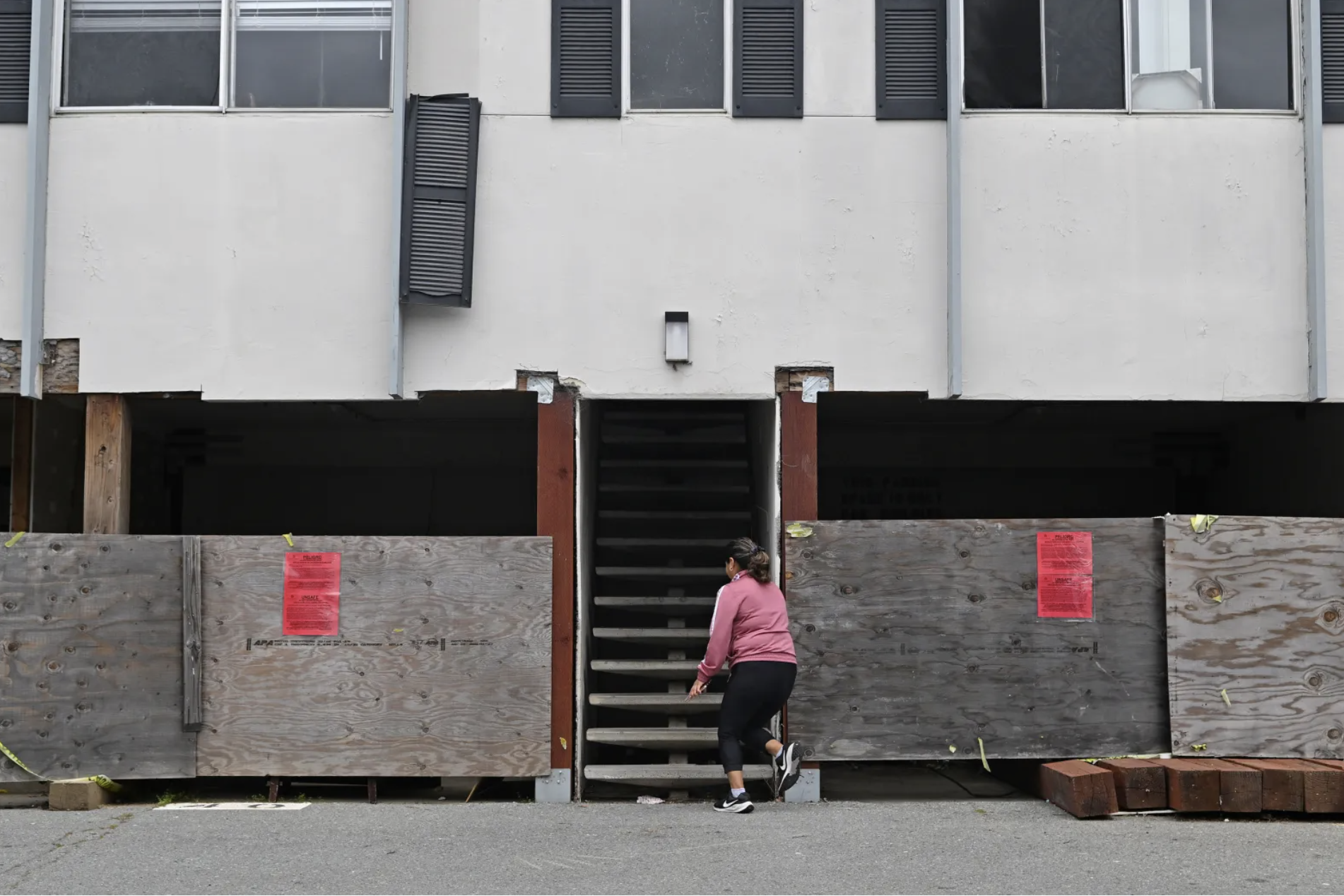
Their home, along with every other apartment in their building at 6 Romar Court, was red-tagged by the city last April as unsafe for habitation because of alleged structural problems, fire safety issues, mold, dry rot and other building hazards. Forty-two residents were displaced.
Monzon said they took what necessities they could but had to leave most things behind. What followed their displacement was months of uncertainty, financial distress and disconnection from their community.
“As a single mom, it has cost me a lot to be able to find a place,” Monzon said in Spanish. “Imagine everything you had to do, 15 years living there, everything it has cost you, you have to let it go. … My daughter left all her things.”
Nearly a year after the incident, Novato is preparing a draft tenant protection ordinance aimed at safeguarding renters from the type of evictions that Monzon and her daughter went through. The ordinance focuses on expanding protections for residents facing certain no-fault evictions in which they bear no responsibility for the eviction.
The draft ordinance has been released by the city in both English and Spanish. The city is holding several public information sessions this month before a City Council workshop on March 24.
Most evictions in the Bay Area are associated with non-payment of rent, which would not qualify under the Novato ordinance. The ordinance expands on the state’s tenant and landlord protections and applies to evictions stemming from the residence being withdrawn from the market; the owner moving into the property; the residence being red-tagged; or the building undergoing substantial renovations.
The proposed ordinance would add protections such as requiring various amounts of prior notice for evictions; mandating that certain materials be provided in English and Spanish or the preferred language of the tenant; requiring certain amounts financial relocation assistance and tenant options for rent payments or lease termination; and offering the right to return to a property in some instances.
The ordinance would mandate that the protections begin for tenants on the first day of their lease, as opposed to the full year the state requires. It would also apply to most types of rentals, including duplexes and houses.
Housing advocates say the draft ordinance is a good start to addressing the needs of tenants. They also identified areas in which they hope to see improvements.
“When we look at the example of Romar Court, the state law did not protect those families,” said Gina Guillemette, chief strategy officer for Community Action Marin. “We know that the state law is not strong enough to protect that basic standard of fairness and predictability and stability that this ordinance is designed to put in place.”
Guillemette said it’s important that the final draft keeps adequate financial relocation assistance, language accessibility and protections starting on the first day of renting.
Her organization, which works with low-income populations, sees a disproportionate amount of immigrants, people of color and other marginalized groups facing the biggest housing barriers in the area.
Mandating financial support would help promote stability for families and their communities, Guillemette said, as many displaced residents are forced to move out of area because they struggle to find alternative affordable housing in the tight rental market.
Lucie Hollingsworth, an attorney with Legal Aid of Marin, said she would like to see the ordinance contain a rollback provision that would allow protections to apply to a certain date before the ordinance was passed.
“The concern would be that owners that have poorly maintained properties or are facing potential red tag violations with the city will quickly do mass evictions because it’s cheaper to do it now,” she said.
Guillemette said the protections should apply retroactively to the tenants of Romar Court.
Landlords at an informational meeting on March 3 shared their comments. Many spoke of the fear that small landlords would face unfair burdens from the ordinance and leave the city’s rental market.
“It really doesn’t give the landlord any rights to their own property,” said Fay Thoms, a landlord. “You’re giving all the rights to the tenants.”
“Had we known that this was coming up, we would have not renewed the lease of our current tenants,” said Piedad Kretchmer, another landlord. “Now we are seriously considering selling the house because it is no longer safe for us to have a house under those conditions. And I hope you take this into account because I am sure we are not the only landlords who feel this way.”
Clare Hartman, Novato’s community development director, said all comments the city receives will be provided to the City Council at the March 24 meeting, along with staff recommendations.
“This is a draft ordinance. It’s out there for the sake of discussion. This is not going to be the ordinance that gets adopted,” she said.
Last April, the city ordered Romar Court Apartments LLC, which owns the complex, to make the needed repairs. The Novato Housing and Building Code Appeals Board upheld the order in August. The company appealed to the City Council, which upheld the board’s decision in December.
The status of the repairs was unavailable from the city Wednesday, and a lawyer for Romar Court Apartments could not be reached for comment.
Monzon, who is still reckoning with the effects of being evicted, said that she is grateful the city is considering this ordinance. She said it is important that it moves forward with strong tenant protections so no one else has to experience the same displacement. Her daughter wants the same.
“I don’t want little kids to suffer this,” Joselin said. “We want no more mothers that have children … to suffer like this.”
Originally published: March 11, 2026 at 4:34 PM PDT